A jump rope costs less than a month’s gym membership, fits in a jacket pocket, and can be used on a patch of concrete outside your front door. It is also one of the most metabolically demanding pieces of equipment available — ten minutes of continuous jumping produces cardiovascular work roughly equivalent to thirty minutes of jogging. The catch is that there are several distinct types of rope, they are not interchangeable, and choosing the wrong one for your goal is a quick route to frustration.
Why the type of rope matters
The rope determines how much feedback you get from each rotation, how fast the cable moves, how much your upper body works, and how forgiving the tool is when your timing is off. A featherweight speed rope is genuinely unpleasant to learn on — the cable is too thin and too fast to feel, so every mistimed jump results in a sharp sting. A heavy drag rope used as a conditioning tool in a HIIT session is a completely different experience from a beaded rope used to practise rhythm. Getting these matched to the purpose makes a meaningful difference in both results and enjoyment.
Speed ropes
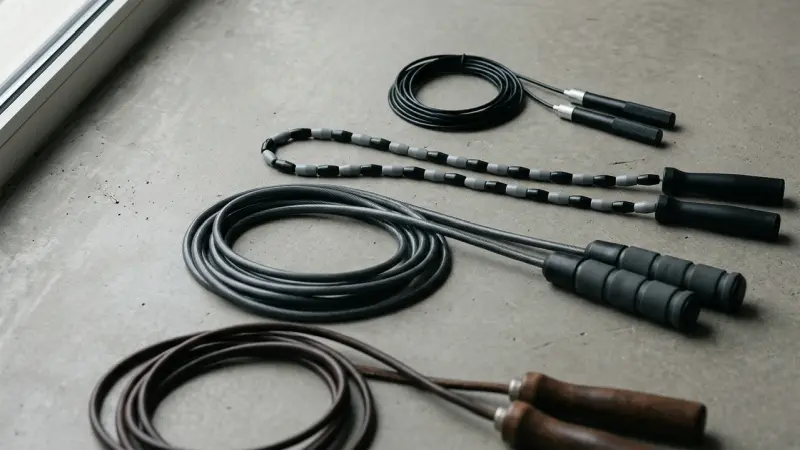
Speed ropes use a thin coated or bare steel cable — typically 2 to 2.5mm diameter — running through precision ball bearings in lightweight handles, usually aluminium. The cable creates minimal air resistance, allowing very high rotation rates. Experienced jumpers can sustain 150 or more rotations per minute on a well-made speed rope, which is why they are the standard tool for CrossFit double-unders and competitive jump rope.
The tradeoff is that speed ropes offer almost no tactile feedback. You cannot easily feel where the rope is in its arc, which makes timing difficult until it becomes automatic. They are also unforgiving when you miss — bare steel cable catches the ankle with genuine sharpness. Speed ropes suit people who already have basic jump rope rhythm and want to push intensity or speed.
The Rogue SR-2S is the most widely recommended all-purpose speed rope for serious training. Knurled aluminium handles maintain grip when hands are wet, the bearing is smooth and consistent, and build durability is high. The RPM Comp 4 is the option for maximum cable velocity, favoured by competitive jumpers, though it is less forgiving to control day-to-day. The WOD Nation Speed Rope is the value pick — comes with a spare cable, has over 11,500 Amazon reviews averaging 4.5 stars, and does everything a recreational or moderately serious jumper needs at well under $20.
Weighted ropes
Weighted ropes add mass to the cable, the handles, or both. The added weight slows the rotation slightly, which has two effects: it creates more tactile feedback — you can feel where the rope is throughout the swing — and it demands more from the shoulders, arms, and core to maintain consistent rotation. These ropes produce a genuine upper body conditioning stimulus that a speed rope does not.
Counterintuitively, weighted ropes are also the better learning tool for beginners. The weight makes the arc feel predictable, which helps timing click faster than it does with a near-invisible thin cable. Many experienced coaches recommend learning on a lightly weighted rope and transitioning to a speed rope once the movement is consistent.
The Crossrope Get Lean Set is the most consistently recommended option in this category. It includes two cables — a quarter-pound and a half-pound — with a fast-clip system allowing swaps between them in seconds using the same handles. The quarter-pound cable is light enough for HIIT intervals and double-under practice; the half-pound adds meaningful upper body demand. Ceramic ball bearings give the handles a notably smooth rotation. Crossrope’s interchangeable cable system means one set of handles works across their entire cable range, so the initial investment scales with your progression. The price is higher than average and cables are sold in fixed lengths based on height, which limits sharing between people of significantly different heights. The Crossrope Get Strong Set includes one-pound and two-pound cables for people specifically pursuing upper body conditioning and power endurance rather than cardio.
The RX Smart Gear EVO G2 is the premium option for a fully customisable, highest-specification single rope. Handles are aerospace-grade aluminium with diamond knurling and a patented dual-bearing swivel, and cable weight, length, and colour are chosen at purchase. It is the best-built option tested by most reviewers and the most expensive by a clear margin.
Beaded ropes
Beaded ropes thread a nylon or plastic cord through a series of plastic beads. They are slower than both speed and weighted cable ropes, resistant to tangling, and produce an audible click on each rotation that helps with timing. They are the standard tool in many jump rope sports communities for learning footwork patterns and complex crossing skills, and they hold up well on rough outdoor surfaces where a coated steel cable would wear quickly.
Beaded ropes are not primarily a conditioning tool. Their value is in skill development: crossovers, double-unders practise at a learnable pace, freestyle patterns. Anyone working on jump rope as a skill rather than purely as fitness conditioning will find a beaded rope useful. Expect to pay $20 to $40 for a quality option.
Drag ropes and heavy conditioning ropes
Drag ropes — like the RX Smart Gear Drag Rope — use braided polypropylene that creates substantial air resistance with every rotation. This is a different beast from a weighted cable. The drag forces effort through the entire swing rather than just adding static weight, producing a distinctive aerobic and muscular fatigue that experienced jumpers describe as among the most demanding conditioning tools available. These are not beginner tools and are not designed for speed or skill development — they exist specifically to make conditioning harder.
How to size a jump rope
Sizing matters more than most people expect. A common starting point: stand in the middle of the rope with one foot and bring the handles up — they should reach roughly to your sternum or armpit height. Beginners generally benefit from a slightly longer rope, which is more forgiving on missed timing. As skill develops, rope length can be shortened, which tightens the arc and forces cleaner mechanics. Most quality ropes allow adjustment either by trimming the cable — a one-time change requiring wire cutters — or through a built-in adjustment system.
What to actually buy
For most people starting out, a lightly weighted rope — the Crossrope Get Lean Set or a similar half-pound option — is the better starting point than a speed rope. The feedback accelerates learning and the upper body demand makes it more useful as a conditioning tool across a wider range of fitness levels. A cheap plastic rope from a sports department store is worth skipping; the feedback is poor and they tangle readily.
If you already jump comfortably and want to add speed or train double-unders seriously, the Rogue SR-2S covers most needs at a fair price. The RPM Comp 4 is the step up for maximising rotation speed. If you want one rope that does everything adequately and will last indefinitely without much care, the WOD Nation is hard to fault at the price.
One note on calorie figures: jump rope marketing sometimes cites numbers around 1,000 calories per hour, which applies only to high-intensity continuous jumping that most people cannot sustain. More realistic moderate-pace jumping burns around 100 calories per ten minutes for an average adult — still an efficient rate, and enough to make jump rope a genuinely useful conditioning tool when used consistently.