The fitness tracker market in 2026 looks very different from what it was even three years ago. The gap between a $50 band and a $400 sports watch has narrowed considerably on the basics. Heart rate tracking, sleep monitoring, and activity logging are now competent at almost every price point. What you’re really paying for as you go up in price is accuracy under demanding conditions, GPS quality, battery life, recovery analytics depth, and the software that makes sense of all the data. This guide breaks down the landscape by tier and by use case, with honest notes on what the research says about tracker accuracy in general.
What fitness trackers are actually good at
Before recommending specific devices, it’s worth being clear about the limitations. A meta-analysis of 45 studies found trackers are most accurate for heart rate (around 76%), moderate for step count (around 69%), and notably less accurate for calorie expenditure (around 57%). Calorie burn figures from wrist-based trackers in particular should be treated as rough approximations, not precise measurements. The research also flagged that accuracy varies by skin tone, body composition, and activity type, with walking tending to produce less accurate readings than running.
Sleep tracking is the other area where manufacturer claims consistently outrun the evidence. Consumer wrist devices approximate sleep stages using heart rate and movement, not the electroencephalography used in clinical sleep studies. Stage estimates — particularly REM and deep sleep — should be understood as indicative rather than precise. The broad sleep duration and consistency data is more reliable than the stage breakdown.
Heart rate tracking is most accurate at rest and during steady-state exercise. High-intensity interval training, wrist movement-heavy activities, and cold conditions can all cause optical heart rate sensors to misread. A chest strap remains the reference standard for heart rate accuracy during intense exercise if precision matters for your training.
Best value: Under $60
The Xiaomi Smart Band 10 (around $53) is the most capable budget tracker available. The 2025 release upgraded the AMOLED display significantly, and independent testing found heart rate accuracy considerably improved over previous Band models, with accurate readings at rest and during moderate workouts. Battery life reaches 10 days in real-world use with all features enabled, and up to 21 days in basic mode. The weak point, confirmed by multiple independent reviews, is sleep staging accuracy — the sleep duration and schedule data is usable, but the stage breakdown should not be taken literally. For someone who wants solid daily activity tracking, heart rate monitoring, and basic sleep data without spending more than is necessary, this is the default recommendation.
The Huawei Watch Fit 4 (around $80–100 depending on region) steps up from band to smartwatch form factor without dramatically increasing the price. It offers more accurate GPS than the Smart Band, better coaching tools, and a more comfortable long-wear design for people who want a watch rather than a band. Availability varies by country due to Huawei’s restricted market access in some regions — worth checking before considering it.
Best all-round performer: $150–300
The Garmin Forerunner 265 (around $449, though frequently discounted to $350 or below) and the Polar Vantage M3 (around $399) are the two most recommended options for people who train seriously and want reliable data. Both offer dual-band GPS, which meaningfully improves accuracy in dense urban environments and tree cover compared to single-band GPS. Both have robust training analytics and recovery tracking. The Vantage M3’s biosensing technology reduces interference from movement for more accurate heart rate readings in some conditions; independent testing found the GPS reliable but heart rate tracking slightly less consistent than the Forerunner 265 during high-intensity anaerobic efforts. Battery life for the Vantage M3 is seven days in smartwatch mode, which is shorter than comparable Garmin models at the price. The Forerunner 265 typically lasts 13 days.
For a slightly lower price, the Garmin Vivoactive 5 (around $250) offers a capable package with Garmin’s Body Battery recovery metric, VO2 max, HRV tracking, and a solid AMOLED display in a lighter, less sports-specialist form factor. It is a better daily-wear option than the Forerunner series without sacrificing the recovery analytics that make Garmin genuinely useful for training management.
Best for serious athletes: $400+
The Garmin Fenix 8 is the benchmark for high-performance wrist-based tracking. GPS accuracy, independently tested, averaged 1.4 bpm variance from a chest strap reference — genuinely strong for optical wrist-based HR. Multi-band GNSS tracking maintained accuracy in forests and urban canyons where lesser devices struggle. Battery life reaches 18 days in smartwatch mode and up to 149 hours with GPS and solar charging. The cost is significant — around $700 to $900 depending on model variant — and the feature set goes well beyond what most recreational exercisers need.
The Apple Watch Series 10 sits in this tier at around $400, but it serves a different primary purpose. It is the best option for people already in the Apple ecosystem who want seamless integration with iPhone and access to the full Apple Watch app library. Its fitness tracking is solid for most recreational uses. Battery life (18 to 24 hours in real-world use) means daily charging — a meaningful practical constraint compared to Garmin alternatives.
A different category: Recovery-focused screenless trackers
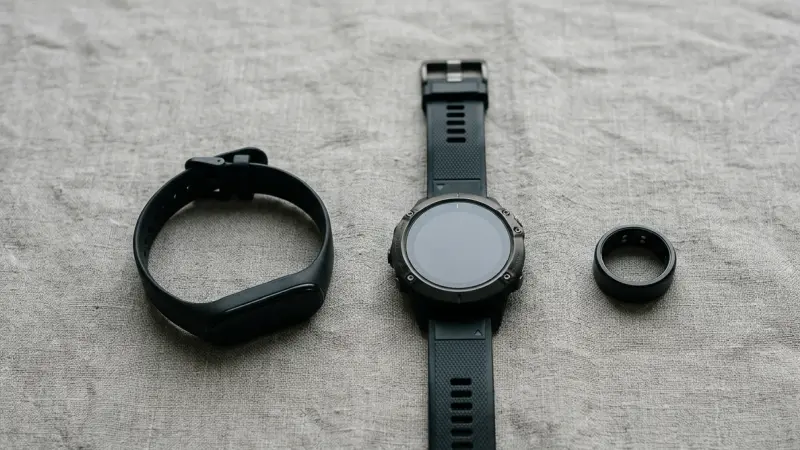
The WHOOP 5.0 and Oura Ring 4 take a different approach entirely. Both are designed primarily around recovery monitoring rather than workout tracking. Neither has a screen. Both produce a daily readiness or recovery score based on HRV, sleep, and resting heart rate. Both require an ongoing subscription after the initial purchase — WHOOP requires a membership (around $239/year) with no upfront device cost; Oura Ring 4 costs around $349 upfront with a $5.99/month subscription for full analytics.
The Oura Ring has become the most widely researched consumer recovery tracker, partly because its form factor suits continuous wear without the friction of charging a watch. Its sleep tracking is generally considered among the most accurate of consumer wearables. The WHOOP 5.0 is most popular with competitive athletes and people doing high-volume training who want strain and recovery coaching without the distraction of smartwatch features. Neither device is designed to replace a GPS sports watch for active workout data — they are complementary tools rather than all-in-one solutions.
What to actually consider before buying
The most common mistake is buying for features you will not use. If you want daily activity awareness and sleep data, spend $50 to $100 and put the rest toward something else. If you run regularly with GPS routes, the jump to dual-band GPS is worth it — the accuracy improvement is real. If your goal is managing training load and recovery over time, recovery-focused tools like Oura or WHOOP serve that purpose better than a feature-heavy smartwatch you wear reluctantly. Subscription costs add up — factor them into the total cost of ownership over two to three years when comparing devices. And wherever you fall on the price scale, treat calorie burn figures as estimates and sleep stage data as directional rather than clinical.