
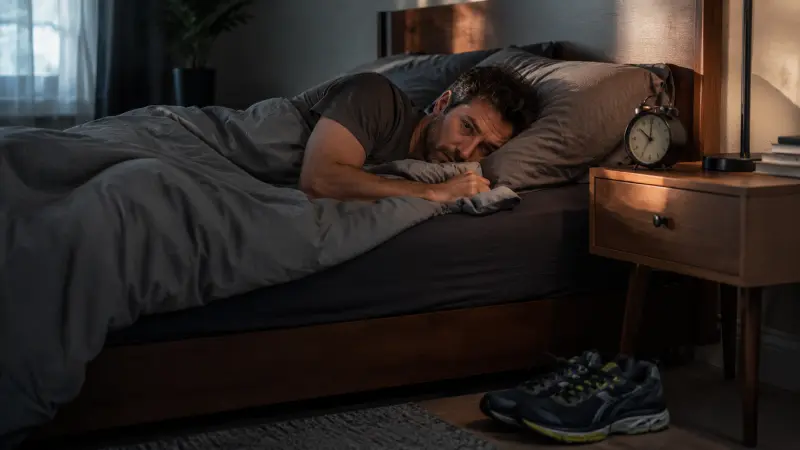
Sleep and exercise have a relationship that runs in both directions, and the fitness world has been slow to treat it that way. Training content is abundant. Serious coverage of sleep as a performance and recovery variable is not. The research on how each affects the other is more developed than most fitness content acknowledges, and some of it pushes back on widely held assumptions.
What poor sleep does to training
The effects of sleep deprivation on strength performance are real but more nuanced than often presented. A single bad night has a limited effect on maximal strength — if you slept badly last night, your one-rep max is unlikely to collapse. Endurance, repeated sprint performance, reaction time, and perceived exertion are more sensitive. The same workout feels harder when you are underslept, and performance over multiple efforts degrades more than single-effort strength does.
The larger problem is chronic restriction. Five nights of sleeping four hours per night has been shown to lower muscle protein synthesis rates in young men. A 2021 study published in Physiological Reports found that a single night of total sleep deprivation reduced postprandial muscle protein synthesis by 18 percent in healthy young adults. The mechanism involves hormonal disruption: sleep deprivation elevates cortisol and reduces testosterone, growth hormone, and IGF-1, the hormonal environment that supports protein synthesis and tissue repair. Chronic short sleep pushes the body toward a catabolic state, regardless of how well you are eating and training.
Growth hormone release follows a predictable pattern: the largest pulse occurs during slow-wave deep sleep in the early part of the night. Disrupted or shortened sleep cuts into this window. Over weeks and months, the compounding effect is meaningful — and largely invisible to people attributing slow progress to training or nutrition variables when the actual constraint is recovery.
What training does to sleep
Exercise is one of the more consistently effective non-pharmacological interventions for sleep quality. A 2026 narrative review covering studies from 2000 to 2025 found that regular physical activity improves both sleep quality and sleep duration, while sleep disorders reciprocally reduce physical activity levels. A 2024 study in the Journal of Sleep Research found that both morning and evening exercise extended NREM sleep by approximately 22 to 25 minutes compared with a rest day, without significant differences between the two timing conditions.
The intensity question is where the research gets more contested. Moderate-intensity exercise is consistently associated with sleep improvements. High-intensity exercise is more variable — it generally improves sleep over time in people who train regularly, but very high-intensity sessions performed close to bedtime can delay sleep onset and reduce sleep quality acutely.
The evening exercise question
The long-standing advice to avoid evening exercise because it disrupts sleep has been substantially revised by recent evidence. A 2024 systematic review found that short-term evening exercise and high-intensity exercise did not produce significant negative effects on sleep quality as a general finding. A 2024 study measuring objective and subjective sleep found that exercise at any time of day extended NREM sleep without impairing other sleep metrics, leading the researchers to suggest that sleep hygiene guidelines should be updated to stop discouraging evening exercise.
However, a large-scale 2025 study in Nature Communications drawing on data from nearly 15,000 physically active individuals found that later exercise timing and higher exercise strain were both associated with delayed sleep onset, shorter sleep, and lower sleep quality. The distinction matters: low-to-moderate evening exercise appears benign or beneficial for most people; vigorous exercise performed late — within 60 to 90 minutes of bed — is where the evidence for disruption is most consistent. Individual variation also matters here, and a 2024 Frontiers paper noted that evening exercise may be more disruptive for males than females. This is contested and worth further research.
The practical takeaway is more permissive than traditional advice: exercise at whatever time fits your life, but pay attention to your own response when sessions are both hard and late. If you regularly train intensely in the evening and sleep poorly, the timing is worth adjusting before concluding your sleep problems are unrelated.
How much sleep do exercising people actually need
The evidence does not cleanly separate exercising people from the general recommendation of seven to nine hours for adults. What it does suggest is that training volume and intensity increase recovery demands — and sleep is the primary recovery mechanism. Athletes in heavy training blocks who extend sleep consistently show performance improvements, even when they were already meeting the general recommendation. Sleep extension studies have produced meaningful improvements in sprint speed, reaction time, and mood across multiple sports.
Sleep quality matters as much as duration. Seven hours of uninterrupted, high-quality sleep appears more valuable than nine hours of fragmented rest. People who spend adequate time in bed but sleep poorly — a pattern consistent with undiagnosed sleep apnea, high stress, or poor sleep hygiene — may be functionally underrecovered despite meeting the hour count. This is worth considering before adding more training volume when progress stalls.
The loop that closes on itself
One underappreciated finding from the broader research is that poor sleep and low physical activity tend to reinforce each other. Poor sleep can contribute to lower physical activity levels, not just the reverse. People who sleep badly tend to move less, feel more fatigued during exercise, perceive effort as higher, and are more likely to skip or reduce sessions. This creates a pattern that is harder to break than either variable in isolation.
The implication is practical: if you are struggling to maintain training consistency, and sleep is poor, addressing the sleep side of the equation may do more for your training than adding structure to the training itself.