The advice to warm up before exercise is nearly universal in fitness contexts, but the specifics — how long, what kind, and how important it actually is — are less settled than they appear. The evidence is reasonably clear on some points and actively contested on others. What is interesting is how the picture changes depending on age, which rarely gets addressed in general warm-up advice.
What a warm-up actually does physiologically
The physiological rationale for warming up is well-established. Elevated muscle temperature increases the speed of nerve conduction, improves muscle fiber contraction velocity, increases the elasticity of connective tissue, and raises the delivery of oxygen and metabolic fuel to working muscles. Synovial fluid in joints becomes less viscous, improving joint mobility. The cardiovascular system is gradually recruited rather than subjected to an abrupt spike in demand. These are real effects with real consequences for both performance and injury risk.
A 2025 review published in Arthroscopy, Sports Medicine, and Rehabilitation found that dynamic warm-ups have been increasingly supported for both performance enhancement and injury reduction, and recommends at least seven to ten minutes before athletic activity. This is a reasonable minimum for most people, though the optimal duration is not precisely established and likely varies by exercise type and individual.
The static stretching problem
For decades, the standard pre-exercise routine was static stretching — holding a stretch for 30 to 90 seconds per muscle group. The research on this practice has been consistently unflattering. Static stretching performed in isolation before training has been shown to acutely reduce maximal strength, power output, and sprint performance. The effect is most pronounced with long-duration holds (60 seconds or more) and diminishes with shorter holds. A 2019 study confirmed acute reductions in maximal strength and power following a single bout of static stretching.
The mechanism is not fully resolved, but is thought to involve a temporary reduction in neuromuscular activation and altered muscle-tendon stiffness properties. Essentially, the muscle is made more compliant at the cost of some of its ability to produce rapid force — the opposite of what most athletic activities require. Static stretching has a legitimate role in a training program, but the evidence supports placing it after training rather than before, or if used before, keeping holds to 15 to 30 seconds within a broader dynamic warm-up rather than as the primary approach.
What dynamic warm-ups do better
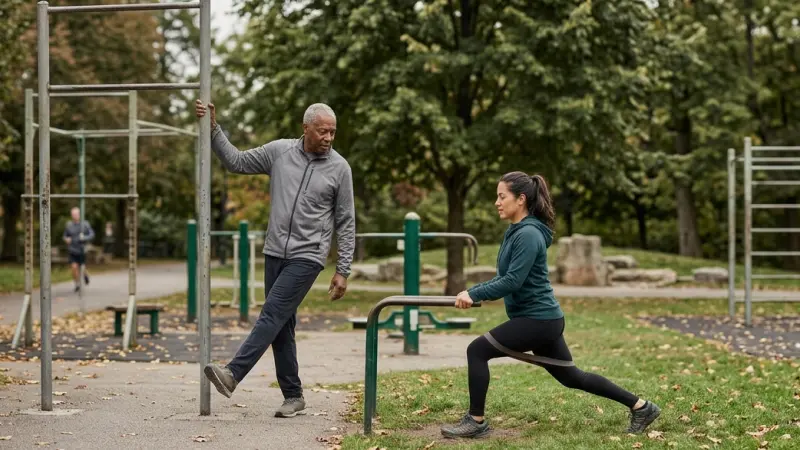
Dynamic warm-ups — controlled, active movements through a range of motion — have consistently outperformed static stretching as a pre-exercise preparation strategy. Active warm-ups that include movements like leg swings, walking lunges, hip circles, bodyweight squats, and arm rotations increase core temperature, activate the nervous system, maintain or improve muscle responsiveness, and prepare movement patterns specific to what follows. An analysis of 31 studies found that active warm-ups incorporating movements like sprints and plyometrics enhanced power and strength performance. For resistance training, warm-up sets at progressively heavier loads accomplish much of the same physiological preparation while also rehearsing the specific movement pattern being trained.
The ICFSR (International Conference on Frailty and Sarcopenia Research) guidelines on older adult exercise summarize the principle simply: the best warm-up for cardiovascular and musculoskeletal systems is to do what is about to be done but at a lower intensity. This holds across age groups and is as practical as warm-up advice gets.
How warming up changes with age
The case for warming up becomes more compelling with age, and the reasons are physiological rather than arbitrary. Several changes accumulate as people get older that make an adequate warm-up more consequential.
Connective tissue becomes less elastic with age, which increases the time needed to prepare tendons and ligaments for the loads they will encounter during exercise. Synovial fluid requires more time to warm and redistribute adequately. The cardiovascular system takes longer to reach a steady state in response to increased demand, meaning abrupt transitions from rest to vigorous activity put greater acute stress on the heart. Muscle protein synthesis also responds more slowly to exercise stimulus in older adults, and the injury consequences of strains or tears — slower healing, greater functional setback — are more severe.
Research on muscle stiffness and aging presents some complexity: some studies show increased stiffness in older muscles due to greater collagen content, while others show reduced stiffness due to myosteatosis (fat infiltration of muscle tissue). The clinical picture is variable between individuals, but the practical implication is consistent: older adults benefit from longer and more thorough preparation before high-intensity or high-load activity. A warm-up that feels adequate for a 25-year-old may be insufficient for a 55-year-old doing the same session.
Morning exercise warrants particular attention for older adults, as body temperature is at its daily low point and connective tissue stiffness is typically at its highest shortly after waking. This does not mean early sessions should be avoided, but it does mean that the warm-up needs to be taken seriously rather than abbreviated.
What the warm-up cannot do
One area where warm-up research is less clear is direct injury prevention. A 2025 paper in the Journal of Science and Medicine in Sport raised important methodological concerns: much of the evidence for injury prevention benefit comes from structured injury prevention programs (like FIFA 11+) that go well beyond conventional warm-ups and function more as conditioning programs. The claim that any warm-up reduces injury risk is not as solidly supported as commonly presented. The well-documented performance benefits — better force production, better range of motion, better movement quality — likely contribute to injury risk reduction indirectly, but the direct causal link between a generic warm-up and injury prevention is harder to establish than most fitness content acknowledges.
Practical conclusions
A minimum of seven to ten minutes of active, dynamic preparation before training is well-supported by the evidence for most people and most contexts. The specifics should match the session: heavier lifting benefits from warm-up sets at progressively increasing loads; cardiovascular exercise benefits from a gradual intensity ramp; sport-specific training benefits from movement patterns similar to what the session involves. Static stretching, if included, is better placed after the session or kept brief within a broader dynamic warm-up. For older adults — broadly speaking, from the mid-40s onward and increasingly through later decades — a longer and more thorough warm-up is not optional caution but a physiologically grounded response to real changes in how the body prepares for exercise.