Protein is probably the most discussed macronutrient in fitness, and the advice ranges from the official recommendations — which most exercise scientists consider too conservative for active people — to the gym floor wisdom of “more is always better.” Neither is quite right. The research gives a reasonably clear answer for most people, with meaningful variation depending on age, training status, and goals.
Why the official recommendation falls short for active people
The standard recommended dietary allowance (RDA) for protein is 0.8 grams per kilogram of body weight per day. For a 70kg adult, that is 56 grams. This figure was established to prevent deficiency in the general population — not to optimize muscle protein synthesis, support recovery from training, or maintain muscle mass during a caloric deficit. Most exercise scientists and sports dietitians consider it inadequate for anyone doing regular structured exercise.
A widely cited 2018 meta-analysis in the British Journal of Sports Medicine, analyzing 49 studies and nearly 1,900 participants, found that protein intake around 1.6 grams per kilogram per day maximized resistance training-induced gains in muscle mass, with diminishing returns above that threshold. The 95% confidence interval extended to 2.2g/kg, meaning some individuals — those with higher training volumes, larger muscle mass, or those eating in a caloric deficit — may benefit from intakes toward the higher end. The 1.6g/kg figure should be understood as a population-level average, not a universal ceiling.
Is more always better?
Not meaningfully, for most people under most conditions. The body cannot store excess protein in the way it stores fat or glycogen. Amino acids not used for tissue building or other metabolic functions are oxidized for energy or converted to urea for excretion. Very high intakes — above 2.5 to 3g/kg — have not been shown to produce additional muscle building beyond what lower intakes achieve when training and total caloric intake are adequate. They are not harmful in healthy people with functioning kidneys, but the incremental benefit for muscle growth is negligible.
The exception is caloric restriction. During a cut or a period of energy deficit, higher protein intakes (1.8 to 2.7g/kg) appear to be more protective of lean mass than the amounts that suffice in a caloric surplus. This is because more dietary protein is diverted to energy production during a deficit, leaving less available for muscle protein synthesis. The practical implication: if you are trying to lose body fat while maintaining muscle, the protein target moves up, not down.
Per-meal considerations
A long-standing belief was that the body could only use around 20 to 25 grams of protein per meal for muscle building, with anything above that being “wasted.” More recent research has complicated this picture. The body can utilize more than 20 to 25 grams per meal for anabolic purposes — the threshold depends on meal composition, protein type, digestion rate, and the individual’s body mass. Larger people need more per meal to hit the same relative stimulus.
What is better supported by the evidence is that distributing protein relatively evenly across three or four meals throughout the day — rather than consuming most of it in one or two sittings — is beneficial for maximizing muscle protein synthesis over 24 hours. A target of around 0.4g/kg per meal across at least four meals is a practical way to achieve this, reaching the 1.6g/kg daily total across meals that each individually provide an adequate anabolic stimulus.
Protein requirements and age
This is where the picture changes significantly. Older adults experience a phenomenon called anabolic resistance — the muscle protein synthesis response to both exercise and dietary protein becomes blunted with age. The muscle simply responds less efficiently to the same stimulus. The consequence is that older adults need more protein to achieve the same anabolic response that younger adults get from lower intakes.
The European Society for Clinical Nutrition and Metabolism (ESPEN) recommends 1.2 grams per kilogram daily for healthy older adults, rising to 1.2 to 2.0g/kg for those with illness or at risk of malnutrition. Research from the Journal of Gerontology suggests that intakes of 1.0 to 1.6g/kg may support better muscle strength and function in older adults, though the evidence on muscle size specifically is more mixed. UCLA Health guidelines recommend 1.2 to 1.6g/kg for older adults, and 1.4 to 2.0g/kg for older adults who exercise regularly.
Per-meal protein also matters more in older adults. Research suggests a minimum of around 30 to 35 grams per meal is needed to adequately stimulate muscle protein synthesis in people over 65 — compared to roughly 20 grams in younger adults. Many older adults systematically under-consume protein at breakfast and lunch while meeting targets at dinner, which means muscle protein synthesis is inadequately stimulated for much of the day.
Does protein source matter?
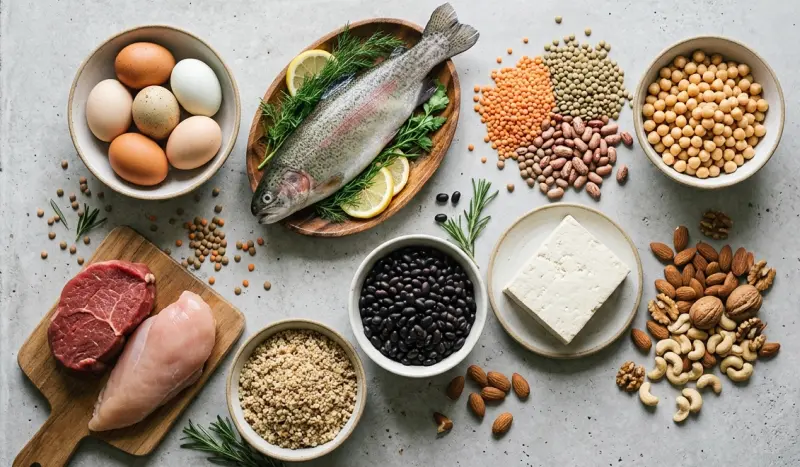
For building and maintaining muscle, protein quality — specifically the leucine content and overall essential amino acid profile — matters more than whether it comes from animal or plant sources. Leucine is the primary amino acid trigger for muscle protein synthesis. Animal proteins tend to be higher in leucine and have better bioavailability, but adequate muscle building from plant sources is achievable with higher total intakes and thoughtful food combining. Whey protein produces a faster and more acute spike in muscle protein synthesis than slower proteins like casein, but the long-term muscle building differences between high-quality protein sources appear to be modest when total daily protein is adequate.
A practical summary
For most active adults under 50: 1.6g/kg per day is a well-supported target, distributed across three or four meals. Higher intakes up to 2.2g/kg are unlikely to hurt and may help during caloric restriction or very high training volumes. For active adults over 50: 1.6g/kg is a reasonable minimum, and 30 to 35 grams per meal — rather than a lower amount spread unevenly — better supports the anabolic response that becomes harder to trigger with age. The RDA of 0.8g/kg is inadequate for anyone training regularly, regardless of age.