
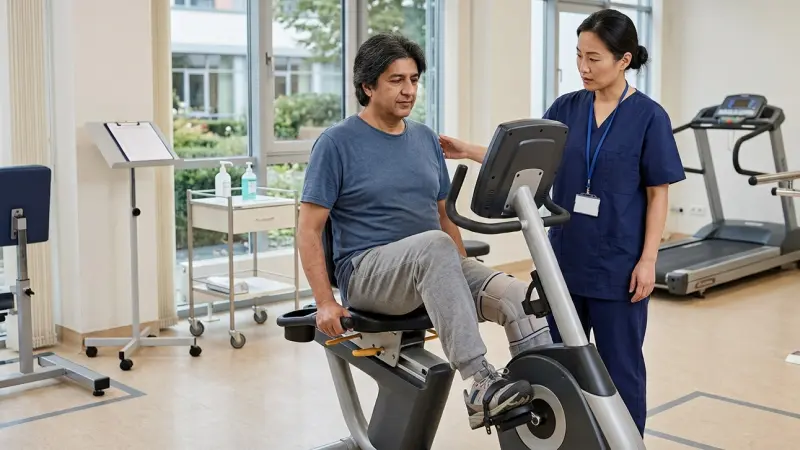
For most of the history of cancer medicine, the advice given to patients during treatment was to rest. The logic seemed obvious: the body is under severe physiological stress, chemotherapy and radiation are exhausting, and pushing patients to exercise while managing these demands appeared counterproductive at best and dangerous at worst. That consensus has been collapsing steadily over the past decade, and in 2025 it received its most definitive challenge yet.
The CHALLENGE trial
The CHALLENGE trial — formally the Canadian Cancer Trials Group CO.21 — enrolled 962 patients with stage II and III colon cancer who had completed surgery and chemotherapy. Half were assigned to a three-year, behaviourally supported aerobic exercise program; the other half received standard health education materials. The trial ran for eight years of median follow-up before reporting results.
The findings, published in the New England Journal of Medicine in 2025, were striking. Patients in the exercise program had a 28 percent lower risk of cancer recurrence, a second primary cancer, or death, and a 37 percent lower risk of death from any cause, compared with those who received health education alone. At five years, disease-free survival was 80 percent in the exercise group versus 74 percent in the control group.
The researchers and accompanying editorialists noted that the magnitude of the survival benefit was comparable to that seen with many approved cancer drug therapies. This is a significant statement in a field where drugs routinely receive approval for smaller survival advantages at considerably higher cost and toxicity. Multiple editorials in major oncology journals argued that the evidence now justifies systematic integration of exercise into cancer care, not as a lifestyle recommendation but as a clinical intervention.
What the broader evidence base shows
The CHALLENGE trial is the most high-profile result in a field that has been building momentum for over a decade. The existing evidence base, prior to this trial, already supported exercise for managing treatment-related side effects, improving quality of life during chemotherapy, reducing fatigue, and maintaining functional capacity. What CHALLENGE adds is evidence that structured exercise after treatment may actually change survival outcomes — not just how patients feel during treatment.
A 2026 pooled analysis in JAMA Network Open found that post-diagnosis moderate-to-vigorous physical activity was associated with significant reductions in cancer-specific mortality, with benefits extending beyond commonly studied cancers like breast and colorectal to include lung, ovarian, endometrial, and bladder cancers. The evidence for exercise reducing cancer incidence in the first place — primary prevention — is also well-established, with epidemiological studies showing up to 24 percent reductions in cancer incidence rates associated with higher physical activity levels.
Research from Memorial Sloan Kettering Cancer Center has explored mechanisms: how exercise might change the biology of cancer itself, alter the tumour microenvironment, enhance immune surveillance, and reduce systemic inflammation — the proposed biological pathways through which physical activity could influence recurrence and survival, rather than merely quality of life.
Pediatric oncology: a new frontier
In June 2026, the American College of Sports Medicine published a landmark Expert Consensus Statement providing the first-ever evidence-based exercise guidance specifically for children and adolescents with cancer. The statement — the product of an international panel screening more than 12,000 studies — concluded that exercise can be performed safely during and after cancer treatment when appropriately supervised and individualised.
Moderate-quality evidence showed that combined aerobic and resistance exercise improves muscle strength and physical function in children with cancer — outcomes that directly affect their ability to move, participate in daily activities, and recover from treatment. The statement’s conclusion was explicit: “Exercise should no longer be viewed as optional in pediatric oncology care.” Children and adolescents undergoing cancer treatment should no longer be encouraged to rest whenever possible. Exercise, appropriately prescribed, should be included as standard supportive care.
A parallel 2026 consensus statement addressed older adults (65 and above) living with and beyond cancer, from the Advancing Capacity to Integrate Exercise Into the Care of Older Cancer Survivors expert panel. This is a population that has been systematically underrepresented in exercise oncology research despite facing compounding challenges — pre-existing sarcopenia, higher treatment toxicity, greater functional vulnerability — that make the exercise question particularly urgent.
The gap between evidence and practice
Despite the accumulating evidence, the translation into clinical practice remains limited. Exercise is rarely formally prescribed as part of oncology care. Most oncologists do not have the training to prescribe exercise programs, and most cancer treatment settings do not have embedded exercise professionals. Insurance coverage for structured exercise programs during cancer treatment is inconsistent or absent across most health systems globally.
The International Society of Exercise Oncology, formally founded in 2024, is one response to this gap — an institution building the workforce, standards, and advocacy infrastructure needed to move exercise from research finding to clinical routine. Its inaugural conference is scheduled for Heidelberg in 2026. Multiple editorialists have used the CHALLENGE findings to argue for dedicated funding for exercise oncology programs at a scale comparable to drug development budgets.
What this does and does not mean
It is important to be precise about what the evidence supports. The CHALLENGE trial was conducted in colon cancer specifically, and its findings cannot be automatically extrapolated to all cancer types. Exercise is not a replacement for chemotherapy, surgery, radiation, or targeted therapies. There are cancer types and stages where exercise prescription must be approached with particular care given treatment toxicity, bone fragility, cardiovascular effects, or other individual factors.
What the evidence does support — increasingly, and now with randomised trial data — is that structured exercise is a legitimate clinical intervention with demonstrable effects on outcomes, not merely a lifestyle adjunct that makes patients feel better while the real treatment works. The framing that was standard a decade ago, in which oncologists told patients to rest and conserve energy, is no longer consistent with the evidence. For patients, oncologists, and health systems, that is a meaningful shift in how cancer care should be conceptualised and delivered.