Is Cardio Underrated, Overrated, or Just Misunderstood?

Woman Running

The cultural status of cardio in fitness circles has swung dramatically. For decades it was the default exercise advice — run more, cycle more, get your heart rate up. Then the strength training revival reframed it: cardio makes you skinny and weak, muscle is what matters, zone 2 is overrated. Now the longevity research has … Read more


What Resistance Bands Can and Can’t Replace

Resistance Bands

Resistance bands have moved from physical therapy tools and travel workout accessories to legitimate training implements backed by a reasonable body of research. The claims made for them have expanded accordingly — some proponents position them as full replacements for free weights and gym equipment. That claim deserves more scrutiny than it typically gets. Bands … Read more

Weightlifting Belts: Who Needs One, and Who Doesn’t?

Weightlifting Belts

Few pieces of gym equipment generate as much confident but contradictory advice as the weightlifting belt. Some coaches treat them as essential safety equipment for any heavy compound lift; others argue they create dependency and mask weaknesses that should be trained directly. The research is more nuanced than either position, and the practical guidance differs … Read more

What We Know About Cold Exposure and Recovery

Man walking into a cold plunge

Cold water immersion — ice baths, cold plunges, contrast bathing — has moved from elite sports recovery rooms into mainstream fitness culture with remarkable speed. The research on what cold exposure actually does is more nuanced than the marketing around it suggests, and the answer differs meaningfully depending on what kind of training you do … Read more

How Much Does Stress Actually Affect Physical Recovery?

Woman looking stressed

Training programs are built around a simple principle: apply stress, recover, adapt. Most programming attention goes to the first element — how to structure training load, volume, intensity, and frequency. Far less attention goes to the recovery side of the equation, and almost none to the role that non-training stress plays in determining whether adaptation … Read more

The Evidence on Caffeine and Exercise Performance

Coffee with people working out in the background

Caffeine has one of the most robust bodies of evidence behind it of any performance-related substance, legal or otherwise. Its ergogenic effects are well-replicated across a range of sports, exercise types, and populations. It is also widely misused — overcaffeinated, poorly timed, or consumed in ways that trade short-term performance for disrupted sleep and long-term … Read more

How Much Protein Do You Actually Need?

Variety of Protein Sources

Protein is probably the most discussed macronutrient in fitness, and the advice ranges from the official recommendations — which most exercise scientists consider too conservative for active people — to the gym floor wisdom of “more is always better.” Neither is quite right. The research gives a reasonably clear answer for most people, with meaningful … Read more

The Research on Warming Up: What Changes With Age

Older man and younger woman warming up

The advice to warm up before exercise is nearly universal in fitness contexts, but the specifics — how long, what kind, and how important it actually is — are less settled than they appear. The evidence is reasonably clear on some points and actively contested on others. What is interesting is how the picture changes … Read more

How Much Does Exercise Order Actually Matter?

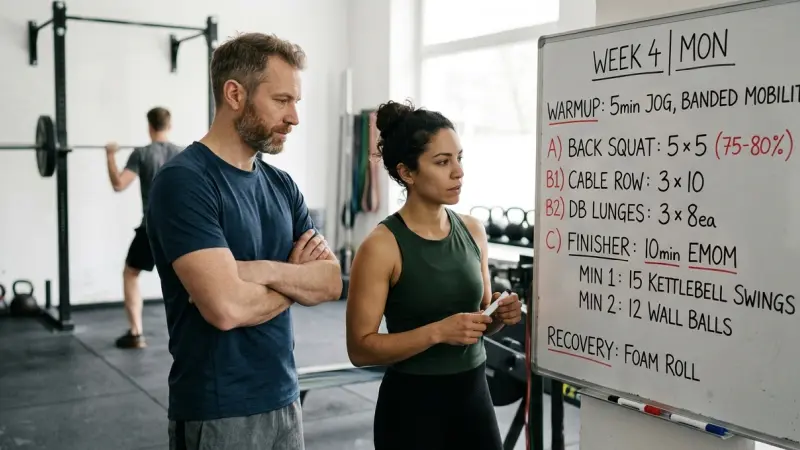
man and woman staring at a board with exercises listed

Exercise order is one of those variables that gets treated as more settled than it is. The standard advice — compound exercises first, isolation work last, priority lifts early in the session — is reasonable as a default. But the research supporting it is less definitive than most training content suggests, and the practical implications … Read more

The Case For and Against Training the Same Muscle Group Twice a Week

Woman on arms machine

Training frequency — how often you hit a given muscle group per week — is one of the more practically important variables in resistance training program design, and also one of the more misrepresented. The debate between “bro splits” (one muscle group per session, once per week) and higher-frequency approaches has generated a lot of … Read more